



This post is by contributor Alexander von Sternberg.
It’s a story that has become about as well-known as any local tragedy that makes national headlines can be. On January 7, 2026, Renee Nicole Good, a 37-year-old mother of three, parked her maroon Honda Pilot sideways on Portland Avenue in Minneapolis, Minnesota, attempting to obstruct the duties of agents from Immigration and Customs Enforcement (ICE). As a result, ICE agent Jonathan Ross approached in his own vehicle. What followed was an altercation, filmed from many angles (including by Ross himself), culminating in Good being shot three times, killing her. As soon as the videos surfaced and went viral on social media, amateur sleuths began a ghoulish game of frame-by-frame analysis to attempt to exonerate either Good or Ross from responsibility for the lethal interaction. With few exceptions, the players involved fell along partisan lines. Meanwhile, Good’s body was still warm.
Given the intensely political nature of both Good’s act of protest and the deployment of ICE agents in Minneapolis amid investigations into one of the largest welfare frauds in recent history, it was inevitable that the Trump administration would become a vocal part of this debate. The Department of Homeland Security wasted no time in declaring Good a domestic terrorist, while many right-wing media figures feverishly scrambled to dig up dirt on the dead woman, as well as her wife, who likely hadn’t even emotionally processed what had just happened. Put simply, federal agents came swooping into Minneapolis and killed a woman, claiming that she tried to run Agent Ross down with her car. The fact that Ross had been dragged by a vehicle in the line of duty in the summer of 2025 provides some insight into his probable state of mind as Good began to move her vehicle in his general direction. At the end of the day, however, something unthinkable to most Americans happened. Depending on one’s political tribe, either a fed had murdered a civilian, or unhinged leftist protesters had escalated their activities to attempted vehicular homicide.
Even while the motives and guilt of those involved in this killing are hotly debated, a sufficient explanation of the broader situation unfolding in Minneapolis has yet to be provided. Defenders will say that, at the president’s behest, ICE has dramatically ramped up the scale and intensity of its activities to properly enforce immigration law in a variety of American cities. Those with high-profile fraud cases involving immigrants would seem to fit that pattern. And yet, something doesn’t add up. Why has a Midwestern city of around 400,000 people — my hometown, as it happens — become such a target of the federal government, seemingly surpassing even my current home of Los Angeles?
ICE agents have descended on the city in numbers that outstrip the Minneapolis Police Department, and yet the number of people with problematic immigration statuses in the entire state hovers around four digits. They have dragged 17-year-old American citizens out of their jobs and roughed them up, snatched five-year-old children from their parents’ cars, and threateningly told residents they’d better learn their lesson, a reference to the Renee Good shooting. How else can one characterize this situation than to say it’s a sledgehammer being deployed against a fly? Why is this happening?
Overkill is certainly one way of putting it. However, as a historian with an additional educational background in psychology, I prefer to call it as I see it: a form of psychological warfare. And while psychological warfare is common enough across world history, one need not look beyond America’s shores, or too deep into the past, to see the precedent of it being used against her own citizens.
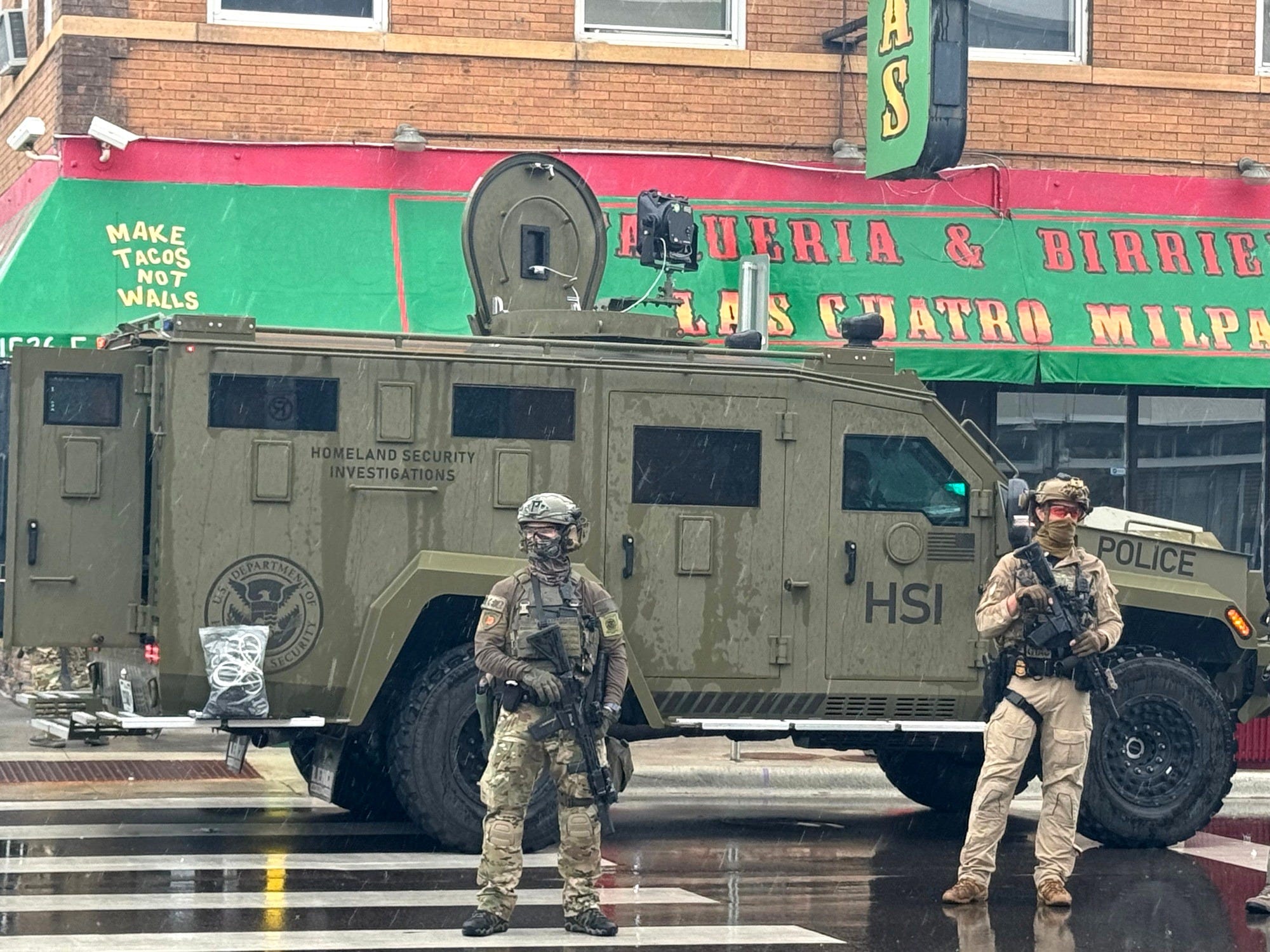
On August 15, 1864, during the American Civil War, ten-year-old Carrie Berry, living in Atlanta with her family, wrote several entries in her diary that have become vital for understanding the psychological impact of war on civilians — including children — living in urban centers. Documenting the bombardment and eventual occupation and evacuation of Atlanta, Berry encapsulated the dread of its inhabitants as they faced the wrath of Union General William Tecumseh Sherman’s troops in their infamous March to the Sea campaign. Berry’s entries reveal childhood terror transformed into numbing habituation. As shells rained down around her, she wrote, “I never was so frightened in my life.” By November, as Sherman’s soldiers moved through the city, Berry recorded the systematic destruction in language that captures the traumatic shock, writing, “They came burning Atlanta to day. We all dread it because they say that they will burn the last house before they stop.”
In her entry for November 16, watching urban destruction unfold, she wrote:
“Oh what a night we had. They came burning the store house and about night it looked like the whole town was on fire. We all set up all night. If we had not set up our house would have been burnt up for the fire was very near and the soldiers were going around setting houses on fire where they were not watched.”
The psychological element — families unable to sleep, forced to watch their city burn, uncertain whether their own homes would be spared — represents pure psychological warfare against civilian populations. It captures the existential stakes, real and imagined, that become embedded in the collective mindset of the populace. General Sherman’s 1864–1865 campaign through Georgia and the Carolinas stands as one of history’s most deliberate and methodically executed exercises in psychological warfare. Far from an improvised rampage, Sherman’s March to the Sea was a carefully planned operation designed not merely to defeat Confederate armies, but to demonstrate the Confederacy’s fundamental inability to protect its own people and thereby shatter civilian morale and the military will to continue fighting. In his October 9, 1864 telegram to General Ulysses S. Grant, Sherman articulated his objective with stark clarity: “I can make the march and make Georgia howl.” His strategy represented a significant shift in American military doctrine — one that contemporaries recognized as a fundamental departure from 19th-century conventions by deliberately targeting civilian morale and economic capacity alongside military infrastructure.
Sherman developed his conceptual framework during the 1864 Meridian campaign through Mississippi. As the military expert Mackubin Owens put it in the Foreign Policy Research Institute, the Meridian operation “provided a blueprint for Sherman’s March to the Sea, [and] was also an example of psychological warfare, meant to destroy any hope the people might have had of a Confederate victory.” Sherman framed his dramatic plan to march through Georgia to Savannah in no uncertain terms: it would merge military and psychological objectives. The destruction would not be indiscriminate; rather, it would be strategically calculated to achieve maximum psychological impact while allowing the army to sustain itself. In another letter to General Grant, Sherman stated that the destruction of “roads, houses, and people” would “cripple their military resources,” but more importantly, it would demonstrate the Confederacy’s weakness. By breaking his army loose from supply lines — a radical innovation that made Confederate cavalry harassment irrelevant — Sherman could force an entire population to witness an unstoppable military force operating with impunity within Confederate territory.
In his December 24, 1864 letter to General Henry W. Halleck, Sherman wrote:
“I attach more importance to these deep incisions into the enemy’s country, because this war differs from European wars in this particular. We are not only fighting hostile armies, but a hostile people, and must make old and young, rich and poor, feel the hard hand of war, as well as their organized armies. [...] We cannot change the hearts and minds of those people of the South, but we can make war so terrible [...] [and] make them so sick of war that generations would pass away before they would again appeal to it. [...] I know that this recent movement of mine through Georgia has had a wonderful effect in this respect. Thousands who had been deceived by their lying papers into the belief that we were being whipped all the time, realized the truth, and have no appetite for a repetition of the same experience.”
The psychological victory Sherman sought was not limited to destruction; it was the shattering of Confederate propaganda, the replacement of false hope with the visible reality of Union invincibility. Sherman’s strategy received formal operational expression in his November 9, 1864 Special Field Orders No. 120, which authorized destruction on a graduated scale. The orders permitted commanders to “forage liberally on the country during the march,” with brigade commanders gathering supplies from areas five to six miles from the army’s route. The orders explicitly scaled destruction according to civilian resistance, making it clear that “in districts and neighborhoods where the army is unmolested, no destruction of such property should be permitted; but should guerrillas or bushwhackers molest our march, or should the inhabitants burn bridges, obstruct roads, or otherwise manifest local hostility, then army commanders should order and enforce a devastation more or less relentless, according to the measure of such hostility.”
Sherman created incentives for civilian passivity by threatening escalating consequences for resistance. Civilians understood that acceptance of the army’s foraging might preserve their homes, while active opposition would result in wholesale destruction. This represents the essence of psychological warfare: the manipulation of incentives and perceptions to achieve military objectives without requiring direct combat.
As seen with the recollections of young Carrie Berry, the emotional impact of Sherman’s advance registered powerfully in the written records of those who experienced it. And it went beyond the city limits of Atlanta. Dolly Sumner Lunt, a Georgia plantation mistress, also maintained a detailed diary documenting the passage of Sherman’s army through her property on November 19-20, 1864. Her entries reveal both the anxious anticipation of the army’s approach and the trauma of its arrival. Preceding the actual encounter, Lunt recorded that she “slept in my clothes last night, as I heard that the Yankees went to neighbor Montgomery’s on Thursday night at one o’clock, searched his house, drank his wine, and took his money and valuables.” This preliminary terror shaped her mindset before the soldiers ever arrived. When Sherman’s forces reached her plantation, the shock was overwhelming. Lunt recalled:
“Like demons they rush in! My yards are full. [...] My thousand pounds of meat in my smoke-house is gone in a twinkling, my flour, my meat, my lard, butter, eggs, pickles of various kinds — both in vinegar and brine — wine, jars, and jugs are all gone. My eighteen fat turkeys, my hens, chickens, and fowls, my young pigs, are shot down in my yard and hunted as if they were rebels themselves.”
The psychological dimension of this destruction and the sense of violation becomes clear in Lunt’s repeated attempts at intervention, in which she “ran out and appealed to the guard,” only to receive the response: “I cannot help you, Madam; it is orders.” Emblematic of psychological warfare, Lunt’s appeals were futile against an overwhelming military force following systematic orders. No individual plea could alter the process.
The final accounting deepened Lunt’s sense of devastation, “leaving me poorer by thirty thousand dollars than I was yesterday morning.” Yet even more telling was her concluding reflection in which she said, “And a much stronger Rebel!” Sherman’s destruction had produced a psychological hardening in this civilian, demonstrating that the destruction achieved its military objective — depriving the Confederacy of resources — while paradoxically strengthening Confederate identification through shared victimhood. Lunt’s greatest psychological terror came not from hunger or property loss, but from the prospect of homelessness. She wrote, “As night drew its sable curtains around us, the heavens from every point were lit up with flames from burning buildings. Dinnerless and supperless as we were, it was nothing in comparison with the fear of being driven out homeless to the dreary woods.”
When one looks at the US Civil War merely through the dimension of its causes — the ongoing debate over slavery and the subsequent secession by the Southern states — it’s relatively easy to make the case that such a strategy was necessary. After all, a message had to be sent that slavery was an abomination. But this analysis misses the mark by overgeneralizing. Sherman was not thinking about the morality of slavery; he was thinking about how to most effectively terrorize the population of another American city and of its citizens, despite their secession. In a September, 1864 letter, Sherman articulated the hard philosophical principle underlying his campaign:
“You cannot qualify war in harsher terms than I will. War is cruelty, and you cannot refine it; and those who brought war into our country deserve all the curses and maledictions a people can pour out. I know I had no hand in making this war, and I know I will make more sacrifices today than any of you to secure peace.”
In other words, this cruelty was a means to an end; to make the people of the Confederacy, the foundation of what was seen as an unjust rebellion, submit to the will of the Union out of sheer terror.
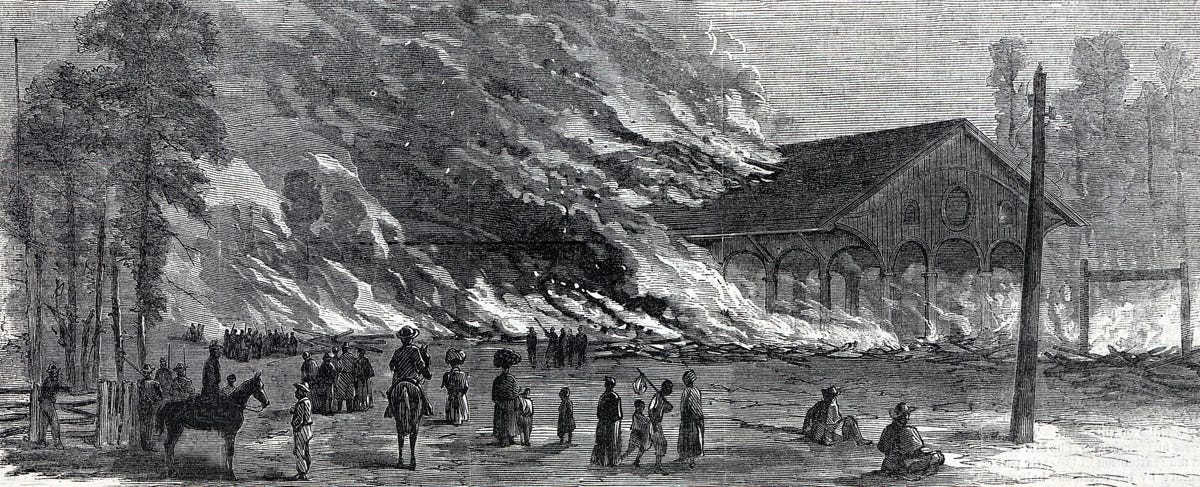
General Sherman’s campaign of psychological warfare against the American South was part of an actual, honest-to-goodness civil war that ultimately killed between 600,000 and 750,000 Americans. The Trump administration seems to be engaging in the same kind of behavior, if a bit more crudely and on a much smaller scale. Of course, unlike in the 1860s, when nothing short of vast devastation was sufficient to break the will of a people, in 2026, viral clips, digital propaganda, and wall-to-wall mass media coverage can enable the same effect with vastly less effort. Still, it’s not a true one-to-one comparison, but then, no comparisons ever are, especially historical ones.
If we are to grant the premise that what’s happening in Minnesota is ultimately a form of psychological warfare against immigrants and their supporters, the bigger and more difficult question is why? We do not have access to the correspondence between the Trump administration and ICE as we have the missives between Generals Sherman and Grant, so we are forced to speculate.
On its face, there’s a strategic calculus to be made regarding the question of self-deportation. The theatrical cruelty of the Trump administration’s deportation efforts are clearly intended to send a message to undocumented immigrants all over the country; that this kind of unpleasantness will happen to you unless you see yourself out. It’s a perversely sound strategy, and even though it would be a mistake to consider it a resounding success, it still contains internal logic. But the administration’s psychological war appears to have another dimension as well. As Edward Kissam of the Center for Migration Studies pointed out, “‘Surges’ in targeted cities where the National Guard is deployed, such as Washington, DC, Los Angeles, Chicago, Charlotte, and Minneapolis, seem to reflect President Trump’s efforts to wound his political enemies.”
To be clear, the United States is not currently in a civil war, but the Trump administration has unquestionably escalated the already strained political polarization that has been mounting for more than a decade. The reality the White House sees is one of ideological combat, part of a culture war that peaked in 2020 with the summer of chaos that unfolded across the country, but which never definitively ended. And the epicenter of that 2020 chaos was one city: Minneapolis.
At first glance, it might seem a stretch to connect the events in Minneapolis in 2026 to the disorder that plagued the city in 2020. After all, the COVID-19 pandemic and its attendant effects likely motivated the scale of the social unrest in 2020 as much as the outrage over George Floyd’s killing. However, the reaction to that killing and the institutional derangement that occurred in its aftermath came to embody everything Donald Trump hated. Moreover, the ways in which the political left excused the events of that summer while decrying the January 6, 2021 Capitol Riots stuck out to many on the right as an intolerable double standard on political violence (of course, the right has shown the same double standard in reverse). In that sense, Minneapolis — a deeply progressive, Democratic city — came to symbolize the very spirit that Trump and his radical right-wing goons in the White House sought to break. Going after a city like Los Angeles or New York or even Chicago would not have the same impact as targeting a city like Minneapolis, whose smaller size and salience in recent cultural history made it an even more perfect mark for Trump’s campaign of ideological vengeance.
Many Minneapolis natives and expats such as myself sympathize with the impulse to exact some form of retribution on those who plunged the city into mayhem and flames, especially when such destruction was assigned moral weight it did not deserve by the institutional authorities we were continually told to trust. But understanding the impulse does not change the fact that the federal government singling out particular cities for crass psychological warfare is beyond grotesque, all the more when it results in a death that should never have occurred, not to mention future violence and the effects of terrorizing the population.1
Even if the goal of this crackdown from ICE was not an act of psychological warfare waged by the Trump administration, that is most certainly the effect it has had. As Leighton Woodhouse reported for The Times of London, there is a diversity of opinion among the Minneapolitan community, but all agree that the city has become the eye of a political hurricane. A reverend from the north side of the city named Jerry McAfee was reported as saying that “the Trump administration is doing everything it can to light a match” to the already short fuse that exists in the city. I can attest to this feeling, even as a former resident. I have seen many people I know back in Minneapolis imploring everyone to stay inside, not engage with any ICE agents, and to avoid protesting. My own mother, a typical politically active progressive-leaning Baby Boomer, said, “I just give up. I’m not putting myself in harm’s way for this.” Given the alarming level of autocratic state force on the ground, one can hardly blame them. The writer Daniel Oppenheimer recently published an email sent to him by his brother that captured the essence of life in my hometown when he wrote the following:
“Indeed it wasn’t real to me until I was seeing it up close and personal. Students of mine crying in my room because they’re scared to come to school. Students not showing up in the first place. Students getting pulled over for no reason and being told their car needed to be searched. Coming to work at a school every day where parents need to surround the premises in case they need to document a student or staff member being assaulted by a paramilitary force and whisked away to a detention center that our elected officials are not allowed to visit.”
This is no way to live, and does not much resemble life in a free country. Many people in a mid-sized Midwestern city that would have once advocated for massive protests are now living in fear of repercussions. “Good!” some might say. “They should be afraid, maybe now they won’t burn down their own city again!” Such attitudes suggest the depressing willingness among many to engage in apologia for brutish, despotic behavior. More to the point, it doesn’t make tactical sense. Psychological warfare might work, at least in the short term, but all it really accomplishes in the long term is the retrenchment of the same kind of radicalism Trump sought to punish in the first place. This is especially the case when it comes to a place that, politically speaking, is partly defined by a self-imposed collective siege mentality.
I discussed the Renee Good killing with a filmmaker, writer, and longtime friend of mine still living in the Twin Cities who goes by Cinema Timshel online. He described a particular social-psychological characteristic of the south side of Minneapolis, seemingly in and around the zip code in which I grew up (the same one in which both George Floyd and Renee Good were killed). He observed that, in his experience, people in the area often had a deeply ingrained sense of insecurity that comes from “passive-aggressive ‘Minnesota Nice’ [people] being in such close proximity to racial minorities who’ve gotten a pretty raw economic deal,” as well as the notion that “Third Precinct cops in particular were, in fact, apparently pretty corrupt and often out of control.” Minneapolitans on the south side, he told me, have “some kind of [psychological] complex” about feeling essentially “besieged” by “a ring of red voters surrounding the city.” This suggestion deeply resonated with me.
That sense of being “under siege” certainly described my experience growing up in the Twin Cities, and was something I observed in others. The Twin Cities and their immediate environs are indeed surrounded by a sea of red counties. However, this is more than just the state itself; Wisconsin, the Dakotas, and Iowa deepen the sense of isolation, with their own blue urban centers sitting hundreds of miles away. The Twin Cities are not just ideologically isolated in their own state; they’re isolated within the wider region.
Broadly speaking, this observation aligns with data that has been collected over the years regarding the “blue metro, red state” phenomenon that has been growing for nearly a century in America. As the political scientist Andrew J. Reeves stated in an interview about his research into this, “There also is a lot of resentment on the part of rural residents toward urban communities. There is a common perception that cities receive more than their fair share of resources and look down on rural communities.” There is no reason to assume that kind of resentment does not run in the opposite direction, particularly from urban residents toward their rural brethren for their inability to “get with the program” of supposed social progress, especially with progressive politics in denial about their self-sabotaged setbacks.
This is all to say that preexisting political and geographic dynamics might help to explain why it feels as if a siege mentality dominates my hometown, particularly in the area where two of the largest law enforcement controversies of the past half decade have taken place. It’s clear that by bringing the power of the federal government to bear and engaging in psychological warfare against one of the cities most outwardly opposed to the Trump administration’s immigration enforcement agenda, this feeling of being besieged from external enemies will only intensify. Perhaps there is a perverse authoritarian strategy at work. It would not be the first time with this administration. But what appears more likely is that the Summer of Floyd painted a target on Minneapolis’s back which the authoritarian chavista in the Oval Office and his vengeance-driven fellow travelers simply cannot resist firing at.
When we observe the ongoing conflict between the Trump administration and cities like Minneapolis through this framing, it becomes difficult to overstate the case for calling the events we have seen a form of psychological warfare. The scale and destruction of the current conflict and the continental war fought between North and South in the mid-19th century are incomparable, but the mentality possessed by everyone involved is strikingly alike. It’s little wonder then why hostility has escalated and spiraled. From the convulsions in Iran to the accounts of Southern survivors of Sherman’s March to the Sea, we see that people can only be pushed around for so long before they decide they have nothing left to lose. How rational their perceptions are only matters as long as they’re actually willing to have a conversation before loading the next clip.
See also: “No, the Trains Never Ran on Time”
Subscribe now and never miss a new post. You can also support the work on Patreon. Please consider sharing this article on your social networks, and hit the like button so more people can discover it. You can reach me at @AmericnDreaming on Twitter, @jamie-paul.bsky.social on Bluesky, or at AmericanDreaming08@Gmail.com. Cover image generated by ChatGPT.
Editor’s note: within an hour of publishing this essay, another US citizen was killed by ICE in Minneapolis.
That was a great read, and a very astute parallel. I imagine even people who voted in favor of immigration enforcement are seeing this and going "This isn't what I voted for."
There are very erroneous statements made about the situation. None of these events would have happened if Minnesota politicians supported federal immigration laws.